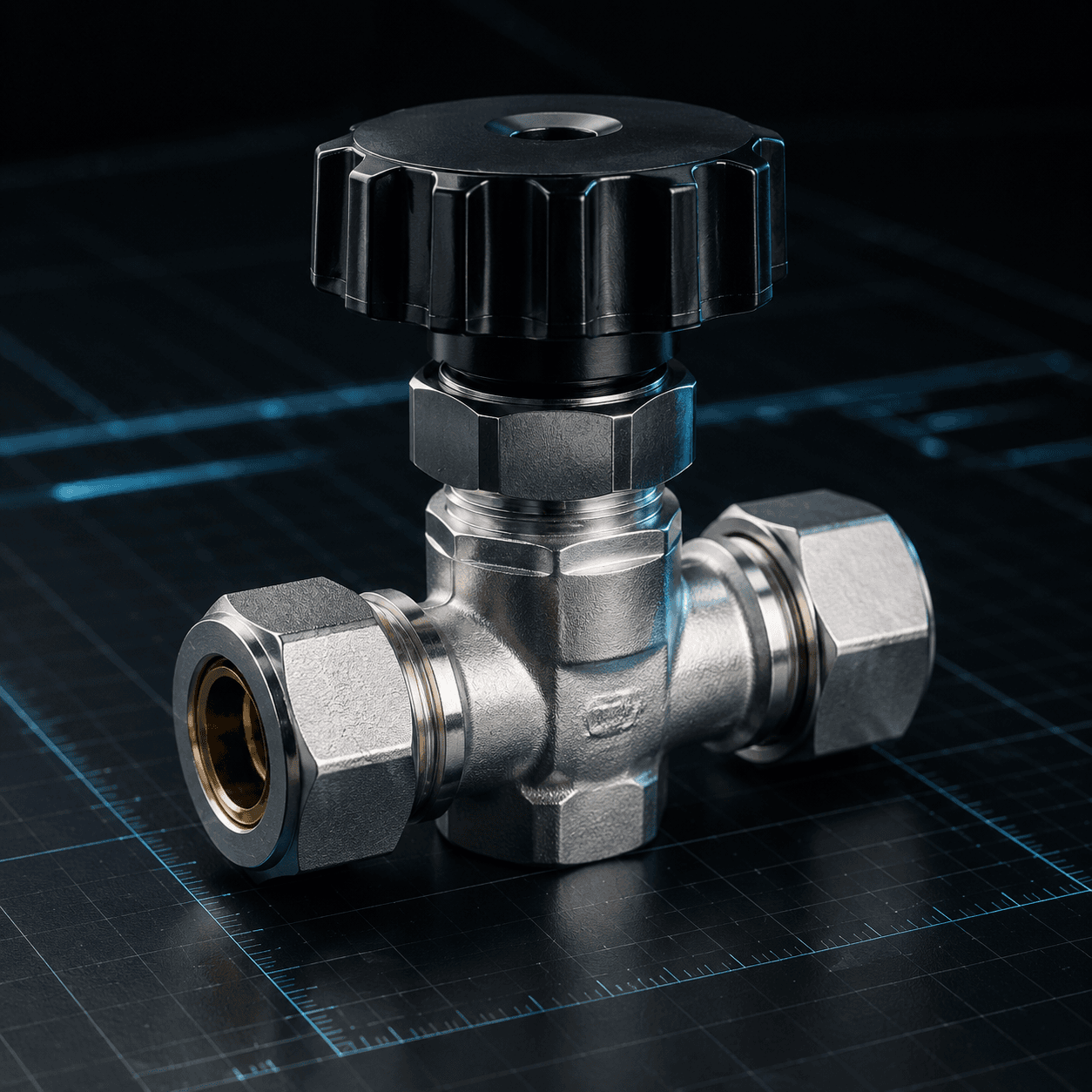
Each record below shows the full output structure for a common fitting family. Notice there are no steps — only what to verify and who to ask.
Looks like a quarter-turn or multi-turn compression stop valve, the kind found under a sink or behind a toilet.
Visual impression only — not verified against the physical part.
Possible size range
- Inlet often 1/2" nominal (3/8" compression outlet common)
- Body diameter typically 1"–1.5"
Common use
Isolates water flow to a single fixture for service.
Shopping checklist
- Confirm inlet connection type (compression vs threaded vs push-fit)
- Measure the actual outside diameter of the pipe it sits on
- Note outlet size for the supply line that connects to the fixture
- Record the valve handle style if a like-for-like look matters
Questions for a licensed professional
- Is this valve rated for my line pressure and water type?
- Does my local code require a specific valve style here?
- Is the connection compatible with my existing pipe material?
Safety stop flags
- Stop if the valve is on a pressurized or main supply line you cannot isolate.
- Stop if you see corrosion, weeping, or mineral buildup around the body.
- Stop and call a licensed professional if water cannot be shut off upstream.
Identification may involve pressure or shut-off considerations — verify before acting. This output is an impression only — never an instruction set. It contains no repair, removal, or installation steps by design.
Resembles a P-trap drain assembly with slip-joint nuts, typically PVC or chromed brass.
Visual impression only — not verified against the physical part.
Possible size range
- Commonly 1-1/4" for bathroom sinks
- Commonly 1-1/2" for kitchen sinks
Common use
Holds a water seal that blocks sewer gas from entering the room.
Shopping checklist
- Confirm trap arm diameter (1-1/4" vs 1-1/2")
- Note material: PVC, ABS, or chromed brass
- Count slip-joint connections and washer sizes
- Check the distance from drain outlet to wall stub-out
Questions for a licensed professional
- Does my drain configuration meet local venting requirements?
- Is a different trap style required for my fixture type?
Safety stop flags
- Stop if you smell persistent sewer gas — that can indicate a venting fault.
- Stop if the connected pipe is glued/solvent-welded rather than slip-jointed.
Commonly a low-complexity part to identify, but still verify specs physically. This output is an impression only — never an instruction set. It contains no repair, removal, or installation steps by design.
Looks like a braided stainless flexible supply line with threaded coupling nuts on each end.
Visual impression only — not verified against the physical part.
Possible size range
- Connector ends often 3/8" compression or 7/16"–1/2" FIP
- Lengths commonly 12"–20"
Common use
Carries water from a stop valve to a faucet, toilet, or appliance.
Shopping checklist
- Identify both end fittings (compression, FIP, or appliance-specific)
- Measure the length needed with a little slack
- Confirm it is rated for hot water if used on a hot line
- Note any appliance-specific coupler (e.g. ballcock vs faucet shank)
Questions for a licensed professional
- Is a braided line acceptable here, or does code require rigid pipe?
- What burst-pressure rating should I be looking for?
Safety stop flags
- Stop if either end connects to a gas appliance — water lines and gas lines are not interchangeable.
- Stop if the existing line shows kinks, bulges, or rust through the braid.
Commonly a low-complexity part to identify, but still verify specs physically. This output is an impression only — never an instruction set. It contains no repair, removal, or installation steps by design.
Appears to be a threaded fitting (elbow, coupling, or adapter) in brass, galvanized, or black iron.
Visual impression only — not verified against the physical part.
Possible size range
- Nominal pipe sizes such as 1/2", 3/4", or 1"
- Thread standard often NPT in the US
Common use
Joins or redirects threaded pipe runs.
Shopping checklist
- Record the nominal pipe size, not the measured outside diameter
- Identify thread standard (NPT vs BSP) before buying anything
- Note the material so it matches the connected pipe
- Photograph the full assembly for a professional to review
Questions for a licensed professional
- Is this fitting on a gas, pressurized, or main line?
- What sealant or tape is code-approved for this material and service?
- Should this joint be inspected or pressure-tested after any work?
Safety stop flags
- Stop immediately if this may be a gas fitting (often black iron or yellow-tagged).
- Stop if it is part of a main line or anything you cannot depressurize.
- This category frequently requires a licensed professional — treat it as professional-only.
Likely involves gas, pressurized, or main-line context. Bring in a licensed professional. This output is an impression only — never an instruction set. It contains no repair, removal, or installation steps by design.